
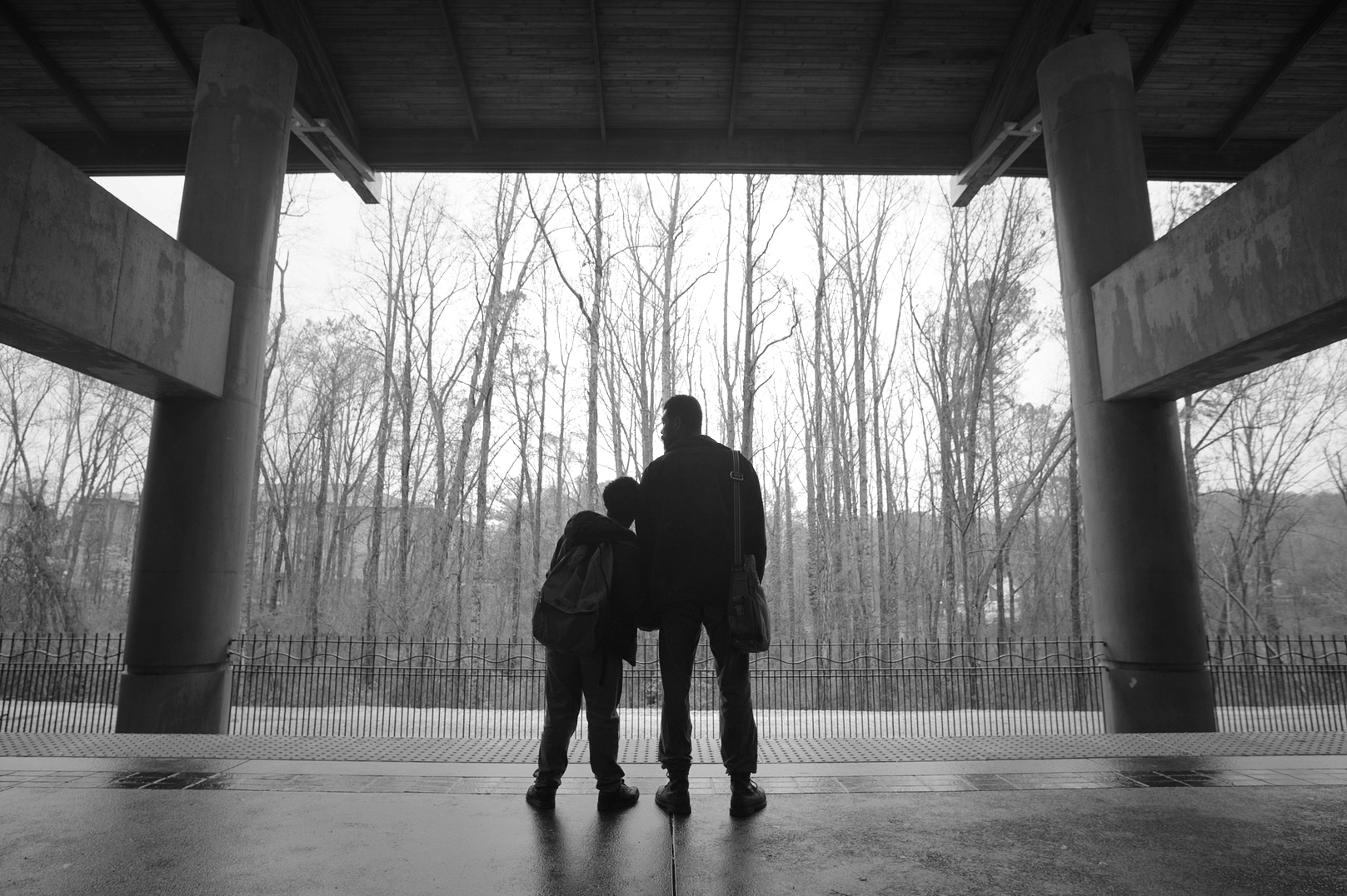
One of the best conversations I had at this year’s AFI Film Fest for this film didn’t physically happen at the festival and revolved around the stunning feature film Color Book. The movie, ironically enough, is filmed in gorgeous black and white and tells the story of love, grief, and particularly the bond between a Black father and his son going through the loss of a dear loved one. The film’s setting of Atlanta provides a beautiful backdrop full of purpose and meaning. The film had its world premiere at the Tribeca Film Festival this year. I talked with cast members William Catlett, Jeremiah Daniels, and Director/Writer David Fortune on a Zoom chat. We discussed their experience at the Tribeca Film Festival, the cast’s experiences making the film, the symbolism throughout the film, David’s visual style, their thoughts on diversity and representation in film, and more.
THE RECLUSIVE BLOGGER: To all, what was experiencing the Tribeca Film Festival like as a cast and I would say cast family?
WILLIAM CATLETT: The Tribeca Film Festival was great, you know, with the cast and everybody seeing the film for the first time, it’s been wonderful. All the film festivals that we’ve been going to have been wonderful, just getting awareness out about Color Book and people seeing it and people experiencing it for their own you know, I think David has done a great job of not forcing people to believe what He wants you to believe. He wants you to experience it for yourself.
THE RECLUSIVE BLOGGER: I would like to direct this question to David as the director, how was it when your movie was picked to be a part of this festival? If I remember reading correctly it was a pitch you had originally submitted for a short film call? How did it feel knowing that film started small and has grown into this?
DAVID FORTUNE: I mean, it was a numbing feeling, right? This started as a short film that I made in 2022, and then deciding to write a feature-length version of that, and be up for the AT&T until Stories award, where they grant you a million dollars to make your first feature film, you know. And so witnessing that journey from a sea, but as it bloomed into this full garden of opportunities, was very numbing, you know, but beautiful at the same time. And going into making the feature film and having it premiered at Tribeca. What’s great about that is that you know that it’s going to show somewhere.
(cont.): You know that this thing is not going to live this hard drive, and it’s just going to just show between or present itself between you and your friends, that the world is going to get a chance to see it. And the most beautiful part about that premier was having all my family, all of our friends, having the support of AT&T Tribeca, you know, all come in to experience this film that we had a chance to work on for about a year. We only had a year time to put the movie together, and having everyone move by the images of Will’s performance with Jeremiah and the celebration afterwards, right? Because there was also an after party. You know, I beat Jeremiah in a dance battle?
THE RECLUSIVE BLOGGER: I would have love to have seen that.
DAVID FORTUNE: So, so that premiere was beautiful, but the biggest thing was to finally show the film in front of a live and present audience.
THE RECLUSIVE BLOGGER: Since you mentioned Jeremiah, who plays the son in the film and film centers around the relationship between the Father and the Son, I’d like to kind of pose this question to Jeremiah. What was it like working with the rest of the cast, and particularly with William?
JEREMIAH DANIELS: But how was it? It was perfect. To working with David. He’s good.
THE RECLUSIVE BLOGGER: Yeah, you could kind of see that come across as you were watching the film. That it felt more like a family rather than a cast as I was watching it. It was lovely.
DAVID FORTUNE: Oh, wow, thank you.
THE RECLUSIVE BLOGGER: You’re welcome. Another thing I noticed too, since it was filmed in Atlanta, was that the backdrop felt less like a backdrop and more like another character in the film. Was that something that you set out for in the beginning, or did it kind of happen organically?
DAVID FORTUNE: Amazing question. You know, when I think about the journey, I feel like it’s three individuals going on a journey. It’s lucky, Mason and Atlanta, right? We experience the highs and low of each of those, right? And Atlanta plays a beautiful part in this film, because simply, you know, the city I always say that is is beautifully complex, right? You have certain experiences where you run into characters that serve as a conflict for Will and Jeremiah, but then in spaces in the community, you see as individuals who serve as a as a help to these two individuals, right? And I always say it’s not one way, but it’s a full circle.
(cont.): I wanted Atlanta to show its authenticity. I just wanted Atlanta to be naturally itself. But through cinematography, I did want to present, you know, a beautiful, humble lens of the city. Because oftentimes we don’t shoot Atlanta, or we don’t visualize Atlanta, and it’s pristine, and it’s story that I feel like is deserved. And I also want to make sure to highlight that visually. And so Atlanta is its own character, its own personality, its own visual language. I just want to see Will and Jeremiah kind of go through that space and deal with the conflict, but also the joys that goes along with being in the city.

THE RECLUSIVE BLOGGER: Yeah. And I, I think the part where I really noticed it the most was a lot of the scenes on the train. I think that was the part where you really kind of are more aware of it. And, yeah, I think that was that filming style really fit. Well, I get, I guess I want to pose this to Will what made you particularly, kind of go for this script. Was there anything that stood out for you?
WILLIAM CATLETT: Yeah, it was working with a kid with Down Syndrome. It was interesting to me. I’ve never worked with a kid that has Down Syndrome, so I wanted to know what that experience is like. And for me, I was quite surprised, because we really don’t know. I always say that Terrence enjoyed it, did a great job, and are doing a great job of raising Jeremiah. Because I didn’t see Down Syndrome when I look at Jeremiah, I don’t see that. I see Jeremiah. I see my son.
(cont.): And, If you’ve been around him, he’s a life of the party. He’s always either listening to music, he’s doing something. So, you know, we’re always playing off each other, even now, like, before you got on. I think that’s my approach. When I play or portray these different roles, I become it, you know, it’s not, oh, I’m only living between action and cut. No, I’m with you the whole time. And like, I’ll know this young man when he’s 25, 30, you know. So I think that really resonates with people when you can feel that type of chemistry on screen and also off screen.
THE RECLUSIVE BLOGGER:I think you, you had mentioned something that was another question, which was, was there any improvised scenes that kind of made it onto the film. And, yeah, that because I seem like there’s a lot of moments within the film, it seemed like it was a real, kind of almost like a real relate, a friendship happening that was happening between the two characters. And, but, yeah, but to go back to. Jeremiah, I just wanted to know where the, what was the filming process kind of like for you? And, yeah, just any, any more, kind of like behind the scenes things, what was it like for you?
JEREMIAH’S FATHER: So, every night we would rehearse the lines, so that way, the next day, he was prepared, and as David would attest to, and Will would attest to, we had it. We did it in a way that he knew both sides of the script, so he knew his own lines as well as Will’s. So he was prepared, and he corrected everybody, when they were were wrong. But you know, the process for him so far is challenging in that it takes, or had taken him out of his normal, everyday being a child, To now being with professionals and being a professional, and becoming a professional himself. He adjusted well, adapted well, and as you were able to see on screen was able to deliver the performance that was required.
THE RECLUSIVE BLOGGER: Yeah, Yeah, I was tearing up in a lot of in a lot of places. I want to go to David again, how do you think your film fits into the current landscape and maybe the kind of the trends in how movies are being made and how a lot of new new filmmakers and undiscovered talent is well, being discovered?
DAVID FORTUNE: Yeah, you know, I don’t think of it in in that type of landscape, if I’m be honest, you know, I don’t see how my film is fitting in or standing out. I just want my film to present its honest truth as itself, whether it’s a trendy movie, or whether it’s fashionable to show Black Father raising a son with Down syndrome, or if it’s not. But I just wanted to present the truth and have people see it for what it is. And if it fits in a box, great, if it doesn’t, great. But here it is, and I hope that it could trail blaze more films after it to say, hey, how do we show people who are disabled, you know, and their stories and their narratives.
(cont.): What if we had a story that focused solely on Mason‘s perspective, right? You know, rather than jump between your father and the son, you know, what? If we just solely focus on the caretakers perspective? You know, I think this films offer a lot of open space for more filmmakers to tell these type of stories when it comes to these communities as well. So I’m looking at it from simply, you know, this film is not trying to follow anything, or it’s just trying to be itself and opening doors for other stories to be told.
THE RECLUSIVE BLOGGER: I get it. I’m hoping more stories get told about black families that are in a wide variety of ways. As we often say, we’re not a monolith, yet it’s still very hard to get our stories told and in different ways. I noticed there’s a lot of symbolism in the film, and I want to talk to you a bit more about that. First thing I noticed was the balloon that Mason carried. Also, I think the biggest thing that stood out to me was the film was named Color Book, but it was shot in black and white. What was your intention behind that, if anything at all?
DAVID FORTUNE: I wasn’t trying to make anything profound with the title. I’m really horrible at selecting titles for film, and so as a result, what I often do is I try to find a piece or a motif in the story or physical item that reflects the spirit of the story, and whatsoever. It could be like a booklet, or it could be like a shoe box, or a crayon. It’s like, oh, that’s the name of the film, because it reflects the essence and the spirit of the movie.
(cont.): I kind of dig deep into the script, and I was like, this coloring book reflects the entire journey. And the idea of this film is about not focusing on the destination, but appreciating the journey that’s in between. So, Color Book, was just that. And I was like, alright, well, the coloring book, it feels like too much. Just say Color Book, right? And so it was just birth out of that small item that reflected the entire scope and spirit of the movie.
THE RECLUSIVE BLOGGER: It makes sense, he had the coloring book with him all the time. And once you get to the end of the film, you realize that, because they didn’t actually get to see the game itself, and that it was about the joy and the journey. So that actually makes a lot of more sense. There’s a lot of symbolism, though. I’m not sure how much time I have left, but I wanted to ask. What do you hope that people take away from this film?
DAVID FORTUNE: I just want people to see the honest struggle, but also the joy between a father and his son, you know. And through seeing these characters, they’re able to see a reflection of their own lives. And through that, you build a sense of empathy from these two individuals in this big city of Atlanta, Georgia. I just want individuals who may have experience raising children with Down syndrome, or not, to say I relate to these characters, and these characters, in the way, relates to me too, that’s it.
THE RECLUSIVE BLOGGER: I should mentioned I’m posing this question to everyone, so the cast as well. I would like to also ask this of Will and Jeremiah too.
WILLIAM CATLETT: What I will say is this is one of the first times you see Black folks exist so beautifully, and we are able, and we can see ourselves in these type of films. Where we can see a city like Atlanta shot so beautifully, and I think it gives us all the liberty to go out and create, to the young filmmaker, you know, to the father who was saying, I don’t know if I can do this, but they see Color Book, and they go back home, and they try to make it work and make it happen. You know, those are type of things of showing up. That’s what I felt when I watch it, and I get something different each time.
(cont.): An example is one of my favorite scenes now, the diner scene. I’m thinking about David, you know, you don’t have that scene if David doesn’t put his money back in to the movie to get that scene. That’s the first time our two characters finally get what they want. I get a patty melt and Mason he gets waffles with sprinkles. And so it shows us who’s watching. It’s okay that you may have been beat down for a while, but you’re going to get what you want at some point, you know. And we get that at the end of the film. So it has different symbolism, like you were saying. I would hope someone will find something that they can grab a hold on to after they watch Color Book.
THE RECLUSIVE BLOGGER: Yeah, yeah, it’s, it was one of those movies where it’s just like it, it’s heavy, but it’s, it’s, it’s got a lot to feel hopeful about. And I guess if I we have time, back to Jeremiah, is there’s anything that you hope that people take away from the film?
JEREMIAH DANIELS: Um, everything is possible.
THE RECLUSIVE BLOGGER: Okay, that’s perfectly said. That everything is possible, and I guess we have to wrap it up now. Thank you so much for this film, Color Book and taking the time out and speaking with me. I absolutely adored it and it was great meeting you guys.
Leave a Reply